The Leadership Skills That Predict Organisational Success

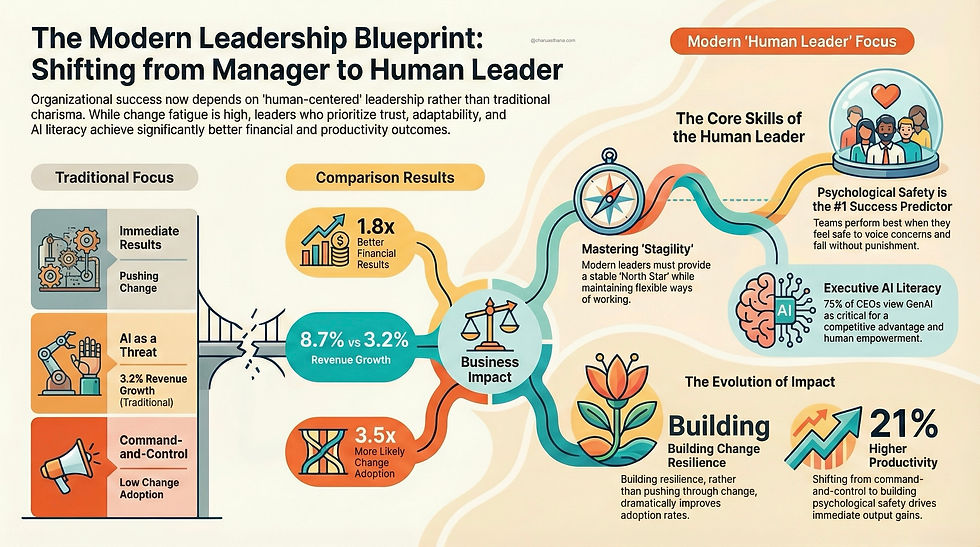
Leadership today isn’t about sitting in the biggest office or having all the answers. It’s about guiding people through constant change, balancing human needs with technology, and creating environments where teams thrive. Research from 2024–2026 shows that organisational success now depends less on charisma and more on a mix of human-centered skills and tech-savvy awareness.
Survey Highlights
Manager quality explains most of team engagement (Gallup, 2025).
Adaptability, collaboration, and authentic leadership are the top global trends (Korn Ferry, 2025).
85% of workers want more agility, but 75% also crave stability (Deloitte, 2025).
73% of employees report change fatigue, while 74% of managers feel unprepared (Gartner, 2024).
75% of CEOs believe GenAI capabilities are now critical for competitive advantage (IBM, 2023).
Core Skills for Modern Leaders
Trust & Psychological Safety
People perform best when they feel safe to speak up and fail without punishment.
Google’s Project Aristotle found that psychological safety is the #1 predictor of team success.
Habit: Begin meetings by inviting one honest concern or idea not yet voiced.
Clear, Empathetic Communication
Alignment + empathy = stronger engagement and performance.
Managers who communicate well drive higher team productivity.
Habit: After explaining a decision, ask: “What concerns might we not be seeing?”
Adaptability & Learning Agility
The business environment changes fast; leaders must learn quickly and adjust.
Industry reports list adaptability as a top trait for 2024–2025.
Habit: Run monthly “what did we learn?” sessions to capture lessons and test changes.
“Stagility”: Stability + Agility
Teams need both a stable “North Star” and flexible ways of working.
Deloitte found that balancing stability and agility boosts long-term resilience.
Habit: Reinforce core values while experimenting with new tactics.
Coaching & Delegating
Developing others builds bench strength and reduces dependency on single leaders.
Surveys show executives worry about succession and talent pipelines.
Habit: Block weekly coaching time to focus on growth, not just tasks.
Executive AI Literacy
Leaders don’t need to code, but they must “speak AI” and use it ethically.
CEOs see AI as a competitive edge, but poor implementation hurts employee experience.
Habit: Treat AI as a co-pilot, ensuring it enhances—not replaces—human work.
Smart Decision-Making Under Uncertainty
Decisive leaders who remain open to new data keep momentum without costly mistakes.
Executive surveys stress balancing speed with accuracy.
Habit: Use a “decision horizon”—agree on how long to wait for data before acting.
Change Resilience
Constant change creates fatigue; leaders must help teams build resilience.
Gartner found that most employees and managers struggle with change adoption.
Habit: Use “micro-moments” to practice new ways of working, instead of big, disruptive shifts.
Collaboration Across Boundaries
Most problems cross silos; leaders must influence without authority.
Global trends emphasize collaboration as essential for 2025 and beyond.
Habit: Invite peers from other functions to co-own initiatives.
The Leadership Shift
Old Leadership (Manager) | New Leadership (Human Leader) | Impact on Success |
Focus on immediate results | Focus on “Stagility” (long-term value) | 1.8x better financial results (Deloitte) |
Commands and controls | Builds psychological safety | 21% higher productivity (Gallup) |
Sees AI as threat/cost-saver | Sees AI as a human co-pilot | 8.7% revenue growth vs 3.2% (Korn Ferry) |
Pushes through change | Builds change resilience | 3.5x more likely to achieve adoption (Gartner) |
Bottom Line
Leadership in 2026 is about trust, empathy, adaptability, coaching, AI literacy, and resilience. The data is clear: when leaders invest in both “soft skills” and “hard skills,” the payoff is not just happier teams—it’s stronger performance, healthier organisations, and long-term success.
"Good leadership hiring predicts behavior - not brilliance."


Comments